

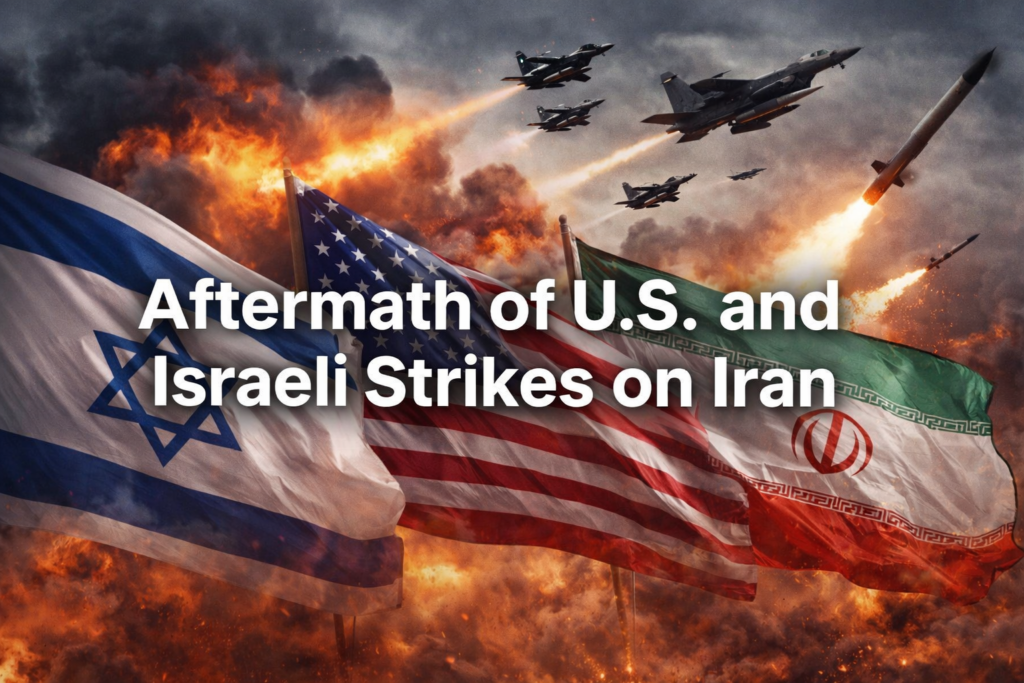
Six months after the United States and Israel launched coordinated airstrikes against Iranian nuclear facilities, the conflict has settled into a tense and uncertain equilibrium. What began as a limited operation intended to slow Iran’s nuclear progress has evolved into a broader geopolitical confrontation with economic, diplomatic and strategic consequences far beyond the original battlefield.
The strikes, carried out in October under the codename Operation Iron Shield, targeted facilities believed by American and Israeli intelligence to be central to Iran’s nuclear program. At the time, policymakers framed the operation as a preventive action designed to delay nuclear development and reinforce deterrence.
Today, however, the longer term effectiveness of the operation remains a subject of growing debate among analysts and officials.
The Military Outcome
Initial assessments from Washington and Jerusalem suggested that the strikes inflicted meaningful damage on several Iranian facilities linked to nuclear development. However, independent reviews have produced more cautious conclusions.
According to evaluations from the International Atomic Energy Agency, the physical damage to several sites appears to have been limited. In multiple locations, operations resumed within weeks of the attack.
The strikes therefore achieved only a temporary disruption rather than a lasting halt to Iranian capabilities.
Iran’s response was swift. Tehran launched missile attacks against Israeli urban areas and targeted U.S. military installations across the region. While defensive systems such as Israel’s Iron Dome intercepted many projectiles and casualties remained relatively limited, the exchanges demonstrated the scale and reach of Iran’s missile arsenal.
Those capabilities have expanded steadily over the past decade despite extensive sanctions.
Iran’s leadership has framed the conflict domestically as resistance against external aggression. Statements by Supreme Leader Ayatollah Ali Khamenei emphasized national sovereignty and defense, messaging that appears to have reinforced internal cohesion according to several regional polling organizations.
Economic Consequences
Beyond the immediate military exchanges, the economic effects of the conflict have become increasingly visible.
Since the strikes began, the U.S. Defense Department has requested more than $150 billion in additional funding related to regional operations and defense commitments. Israel’s military expenditures have also increased significantly, approaching 10 percent of national output according to government figures.
The impact has extended to global energy markets.
Oil prices have risen sharply amid concerns about regional instability. Brent crude has surpassed $120 per barrel, representing an increase of roughly 40 percent since the beginning of the conflict. According to estimates from the World Bank, the surge has intensified inflationary pressures across Europe and Asia.
A central factor in this disruption is the Strait of Hormuz, one of the world’s most critical maritime chokepoints. Roughly one fifth of global oil shipments pass through the narrow waterway.
Iran has periodically interfered with shipping traffic without imposing a full blockade. Even limited disruptions have been sufficient to drive up insurance premiums and force some vessels to reroute, amplifying uncertainty across global supply chains.
Diplomatic Fallout
The military operation has also complicated diplomatic relationships.
Several European governments have expressed reservations about the long term viability of a purely military strategy. Officials in France and Germany have urged a renewed diplomatic framework resembling the 2015 nuclear agreement.
Within the United Nations, resolutions criticizing the strikes have received support from a broad coalition of countries across Latin America, Africa and Asia.
At the same time, regional powers are quietly pursuing their own diplomatic adjustments.
Saudi Arabia and the United Arab Emirates, both long wary of Iranian influence, have engaged in discreet discussions with Tehran in an effort to reduce regional instability and protect critical infrastructure.
These parallel diplomatic efforts suggest that many governments now view the conflict less as a short term military crisis and more as a structural regional challenge.
Competing Interpretations of the Strikes
Supporters of the operation argue that the strikes succeeded in delaying Iran’s nuclear progress and demonstrated a willingness to act against proliferation threats.
From this perspective, the operation reinforced deterrence and signaled that nuclear expansion in the region would face direct military consequences.
Critics offer a different interpretation.
Some analysts draw parallels to earlier American military engagements in Iraq and Afghanistan, where early tactical victories gradually gave way to prolonged conflicts with escalating financial and political costs.
Congressional estimates suggest that the war in Afghanistan alone ultimately exceeded $2 trillion in total expenditures.
For critics, the concern is not the initial success of the strikes but the possibility that the conflict could evolve into another long term strategic burden.
The Path Ahead
Diplomatic talks in Vienna have resumed intermittently as international actors search for a potential framework to stabilize the situation.
Several analysts suggest that a future agreement may involve partial sanctions relief in exchange for verifiable limits on Iran’s nuclear activities and missile programs.
Such an arrangement would likely require extensive international monitoring and a degree of political compromise that has so far proven difficult to achieve.
For now, the conflict remains unresolved.
What began as a limited military operation has evolved into a broader geopolitical contest involving energy markets, regional alliances and competing visions of security in the Middle East.
The episode illustrates a recurring dilemma in modern geopolitics. Military force can alter the immediate balance of power, but it rarely resolves the deeper strategic tensions that produced the conflict in the first place.
